
If you have ever been advised to take a daily calcium supplement for bone strength, joint mobility, or healthy aging, you may be unknowingly making a serious nutritional mistake.
Millions of adults buy standalone calcium tablets, believing that more calcium equals stronger bones. However, modern nutritional biochemistry reveals a surprising truth: taking calcium in isolation can actually do more harm than good.
Without the proper biological co-factors, excess calcium cannot be directed into your skeletal matrix. Instead, it can circulate in your bloodstream and calcify soft tissues.
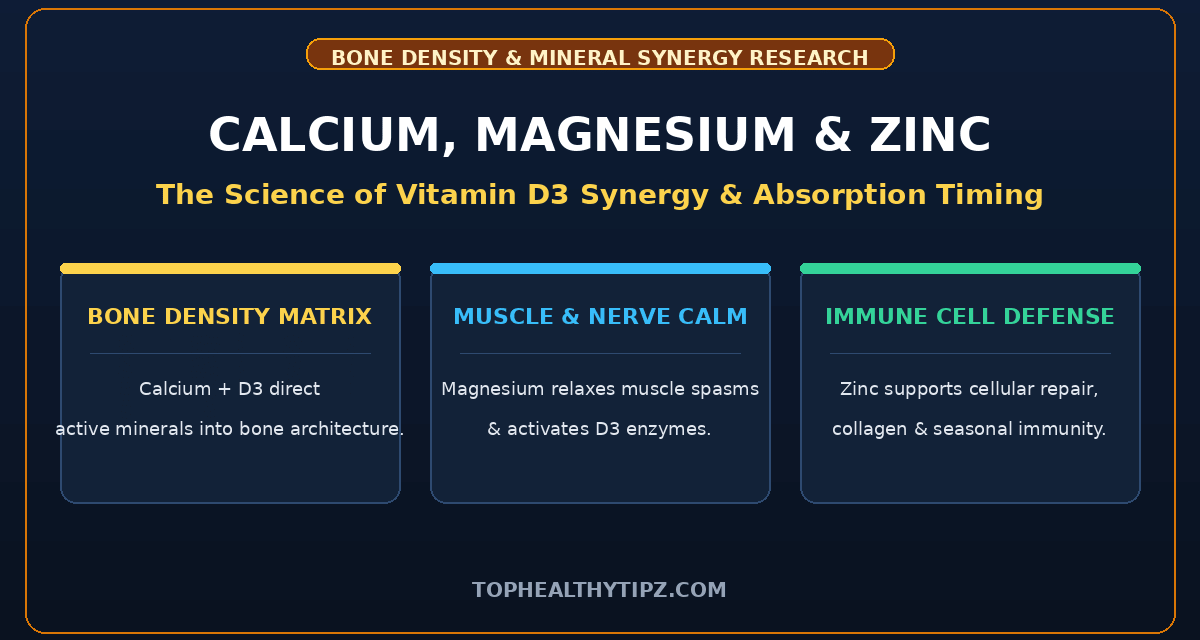
To build genuine bone density, protect cardiovascular arteries, and support neuromuscular function, calcium must always be taken with three essential synergists: Magnesium, Zinc, and Vitamin D3. Here is the clinical science behind this 4-in-1 synergy and how to optimize your daily routine.
—
## 1. Why Calcium Needs Vitamin D3 to Absorb
Calcium molecules are large and chemically complex. When you ingest calcium, it cannot cross the mucosal lining of your small intestine on its own.
This is where **Vitamin D3 (Cholecalciferol)** plays an indispensable role:
* **Cellular Receptors:** Vitamin D3 binds to vitamin D receptors (VDR) in the intestinal wall, triggering the synthesis of calbindin—a specialized calcium-binding transport protein.
* **Absorption Multiplier:** Without adequate daily D3, your digestive tract absorbs less than 15% of dietary calcium, flushing the remainder through the digestive system and causing constipation.
—
## 2. The Magnesium Balance: Preventing Soft-Tissue Calcification
While Vitamin D3 pulls calcium into your bloodstream, **Magnesium** acts as the traffic controller that determines where that calcium goes:
* **Activating Calcitonin:** Magnesium stimulates the thyroid gland to release calcitonin, a hormone that actively pulls calcium out of the bloodstream and deposits it directly into bone architecture.
* **Inhibiting Parathyroid Hormone:** It prevents parathyroid hormone (PTH) from breaking down bone mass.
* **Arterial Protection:** Without sufficient magnesium, unabsorbed calcium can accumulate in delicate arterial walls, kidney tissues, and joints rather than skeletal bone.
—
## 3. The Role of Zinc: Osteoblast Stimulation
Bone is not inert rock; it is dynamic, living tissue constantly breaking down and rebuilding through bone remodeling.
* **Building the Matrix:** Zinc is an essential enzymatic co-factor for osteoblasts (the specialized cells that synthesize new bone tissue) and alkaline phosphatase.
* **Collagen Support:** Zinc supports the structural collagen scaffolding upon which calcium and magnesium crystals adhere, ensuring bones remain flexible and resilient against fractures rather than brittle.
—
## 4. Optimal Daily Timing & Best Practices
* **Take with Food:** Always consume your calcium, magnesium, zinc, and D3 supplement with a substantial meal containing healthy dietary fats to trigger optimal bile acid and digestive enzyme secretion.
* **Avoid High Caffeine:** Do not take your mineral supplement alongside high-tannin tea or coffee, which can bind to minerals and impair intestinal uptake.
🦴 Recommended: Nature Made Calcium, Magnesium & Zinc with Vitamin D3
Clinically formulated 4-in-1 mineral complex providing 333mg Calcium, 133mg Magnesium, and 5mg Zinc with Vitamin D3 to support strong bone density, teeth, and nerve function with superior absorption co-factors.
🎁 Free Download: 2026 Autumn & Winter Supplement Protocol
Master the science of mineral timing. Download our 7-day food-pairing roadmap to maximize calcium absorption and seasonal immunity.